Why Utah
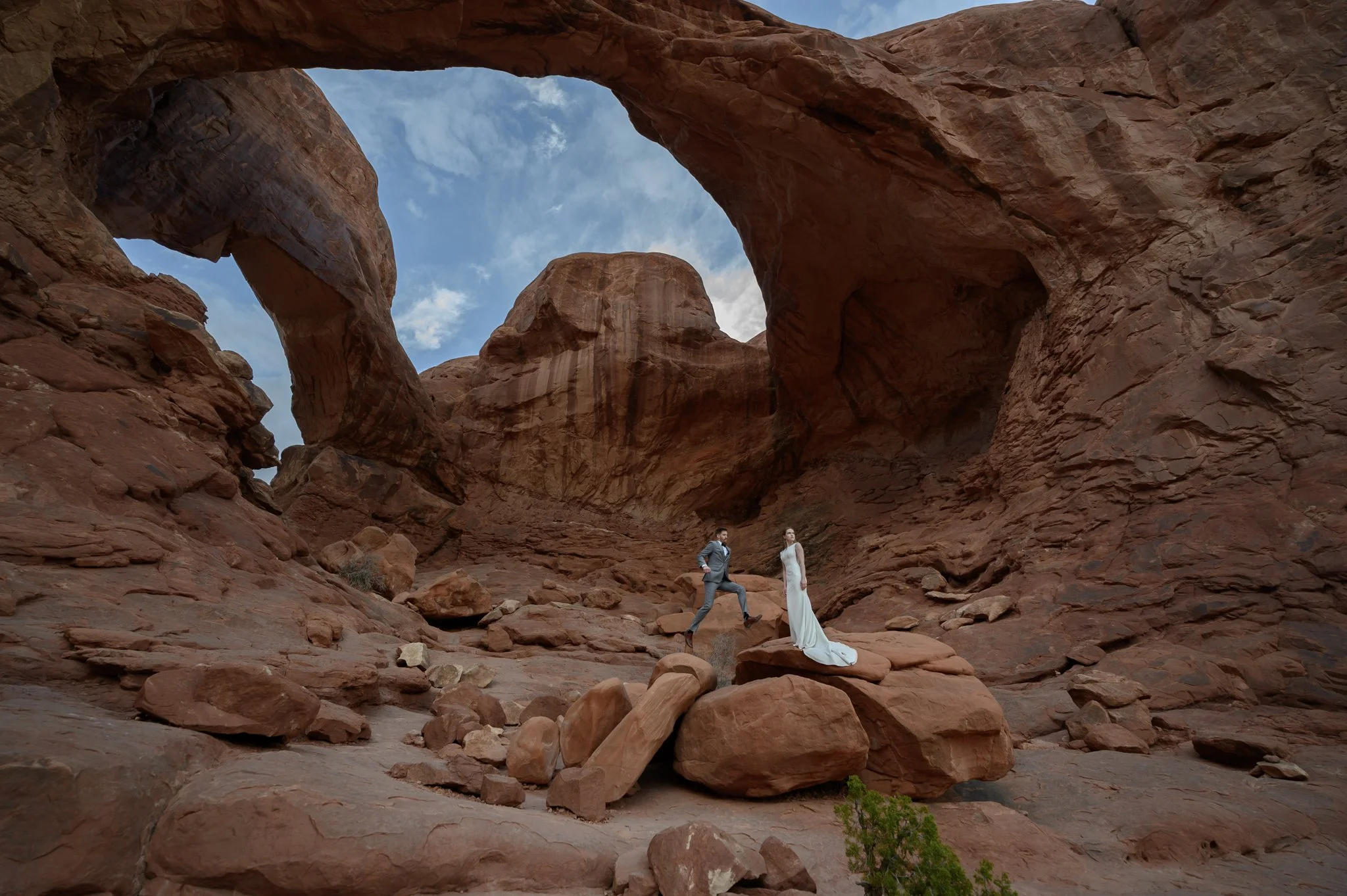
Utah has five national parks within a day's drive of each other, and no two of them look alike. Zion is a green river canyon with two thousand foot walls. Arches is a desert full of impossible sandstone shapes. Canyonlands is a view so big it stops feeling real. Bryce Canyon is an amphitheater of orange spires that glow at sunrise. Capitol Reef is a hundred mile wrinkle in the earth with orchards at the bottom of it.
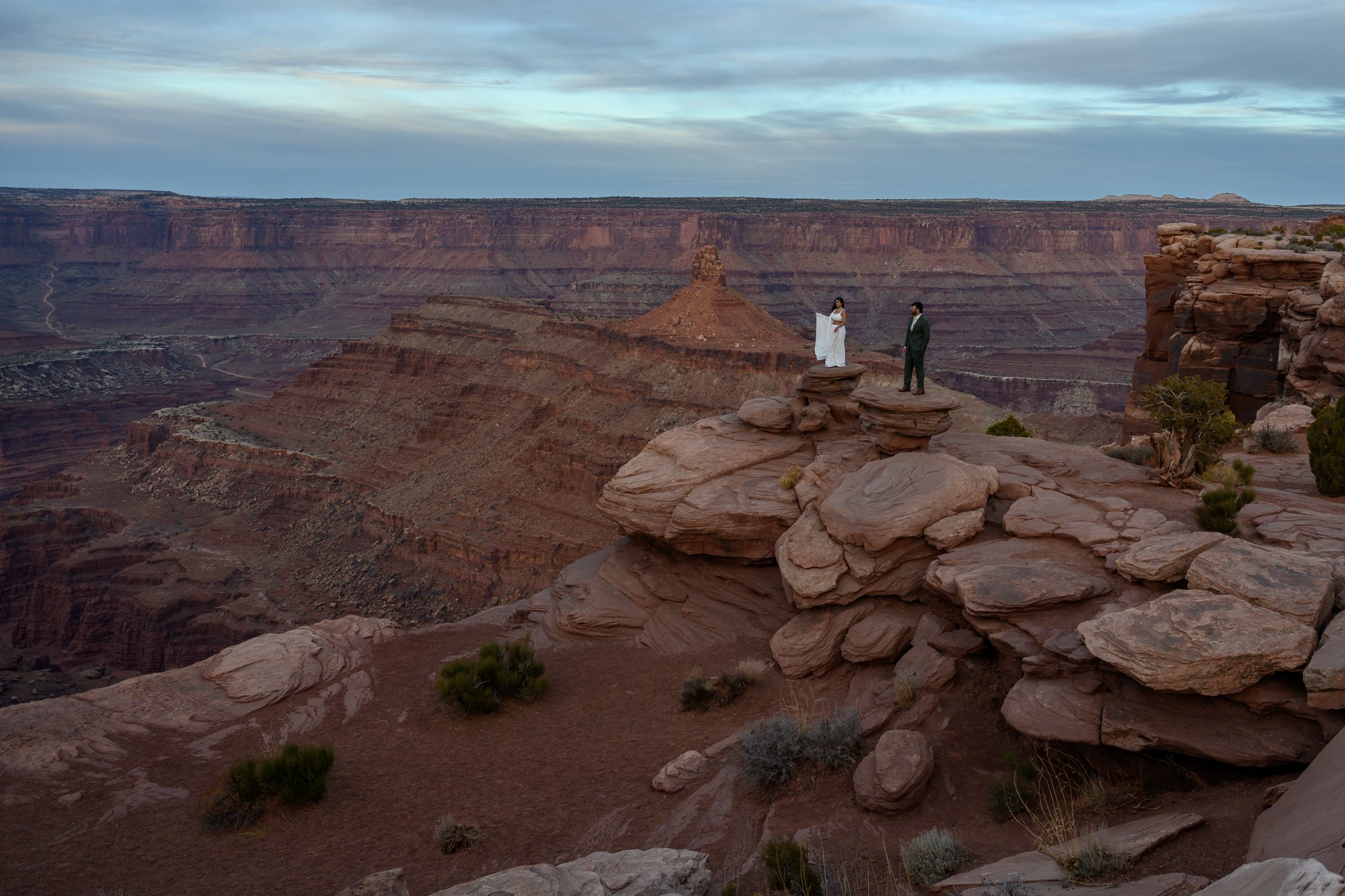
You can elope in one of them, or you can make a road trip out of two or three. And because the light in the desert does things it doesn't do anywhere else, especially in the first and last hour of the day, the photos from a Utah elopement look like nowhere else.
What trips couples up is the paperwork. Every park has its own permit, its own fee, its own list of approved spots and its own rules about what you can and cannot bring. So let's go park by park.
Everything below is current as of when I wrote this, but fees and rules do change. Always confirm with the park before you book flights.
Zion National Park
Permit: Special use permit required for all ceremonies, elopements and vow renewals, regardless of group size. $100 application fee. Applications must be in at least three weeks ahead. Monitoring fees may apply at $50 per hour.
Approved ceremony sites:
Temple of Sinawava, up to 35 people. The end of the canyon road, where the walls close in and the Virgin River runs through. This is the most dramatic ceremony spot in the park.
Menu Falls, up to 10 people. Tiny, intimate, a small waterfall on the scenic drive. Perfect for just the two of you and a witness or two.
Zion Lodge Lawn, up to 75 people. Big cottonwoods, the canyon walls behind you, room for actual guests.
Nature Center Lawn, with a limit of 25 chairs that do not penetrate the grass.
No permit is approved for a group over 100.
What to know. The Zion Canyon Scenic Drive closes to private vehicles from roughly March into November and runs on shuttles instead, which means your whole group rides the shuttle, and you cannot drive chairs or gear up the canyon during that season. Chairs have to be folding chairs. No amplified music or PA system, and noise can't exceed normal conversation. Decorations need prior approval, and live flowers are allowed only if there are no seed pods.
If you want to hike Angels Landing as part of your day, that requires its own permit through a lottery on recreation.gov, either the seasonal lottery months ahead or the day before lottery. That is completely separate from your wedding permit.
My take. Zion is the easiest Utah park for couples bringing family, because the Lodge Lawn holds a real guest list and nobody has to hike. Sunrise at Temple of Sinawava, before the canyon fills up, is the one I'd fight for.
Arches National Park
Permit: Special use permit required. $185 non refundable application fee, paid through Pay.gov before the application goes in. Bookable up to a year in advance. A cost recovery monitoring fee is charged on top, based on the monitor's time and travel. One hour time limit per permit.
Approved ceremony sites and group limits:
Park Avenue, 15 people
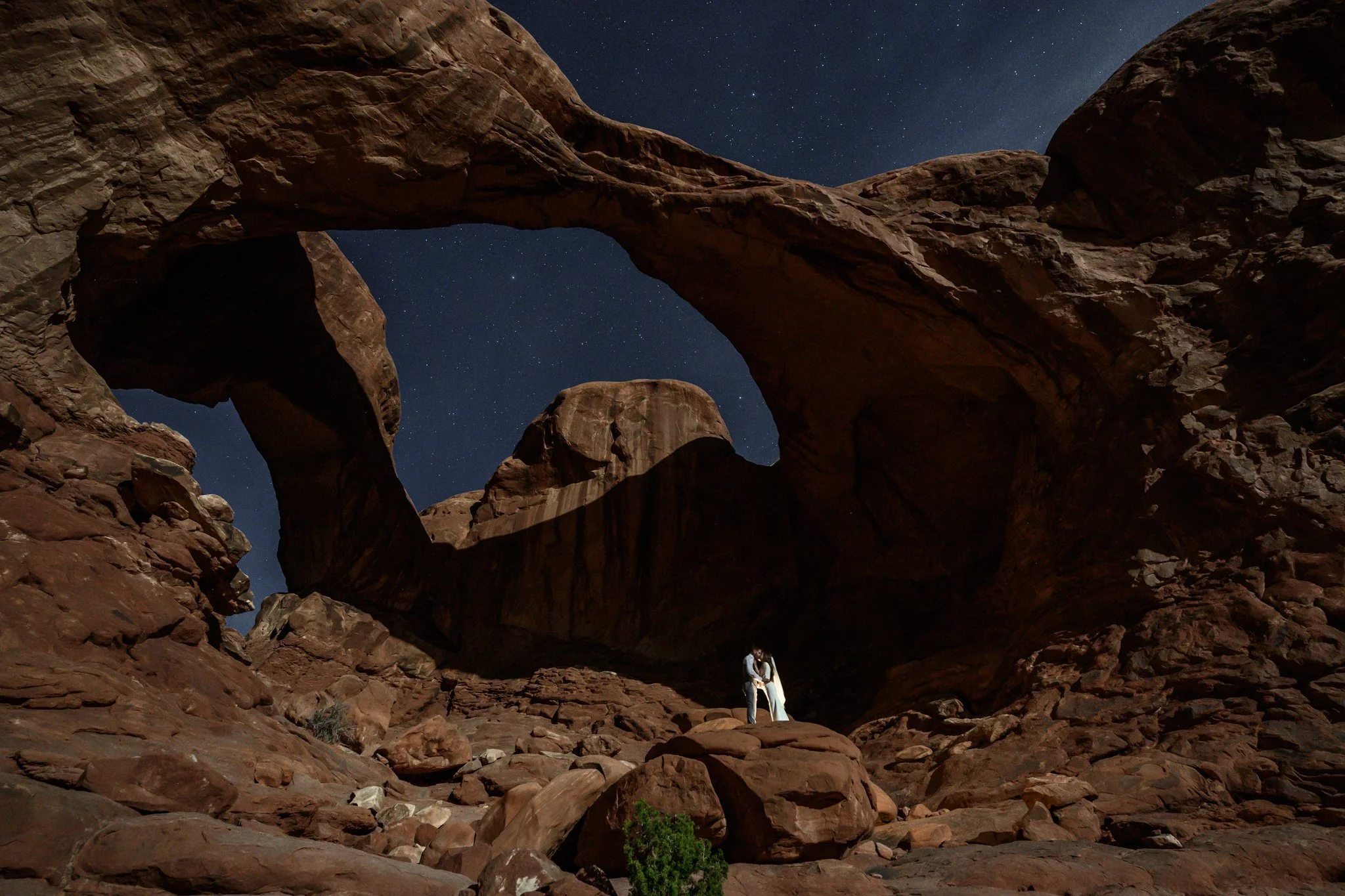
Double Arch, 25 people
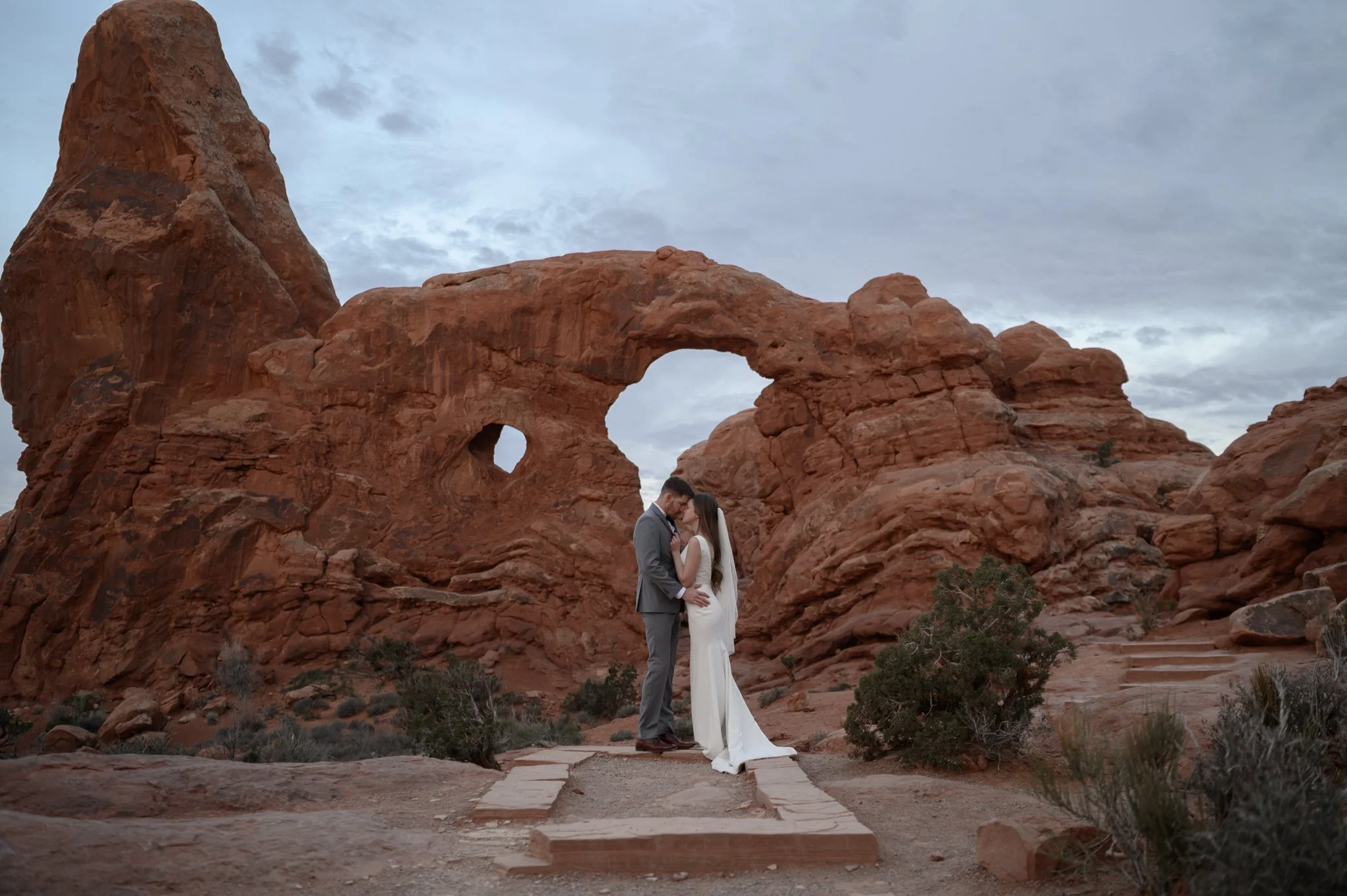
The Windows, 25 people
La Sal Mountains Viewpoint, 50 people
Panorama Point, 50 people
Devils Garden Campground Amphitheater, 80 people
What to know. Notice what isn't on that list: Delicate Arch. It's the most photographed arch in the world and it is not an approved ceremony location, which surprises almost everyone. You can absolutely hike out there for portraits, but your vows happen somewhere else.
Arches lifted its timed entry reservation requirement for 2026, so you can enter any time during operating hours with a valid entrance pass. That's good news for flexibility and it also means the park expects crowds and full parking lots at the popular spots, especially on weekends. Devils Garden Campground and the Fiery Furnace still have their own reservations.
The restrictions are strict. No decorations, no balloons, no arches or structures, no amplified music, no food service or catering, no drones, no releases of anything including rice and petals, and your permit does not close the area to the public. Other visitors will be there. I shoot around them.
My take. Double Arch and The Windows at sunrise. Get in before the lots fill, do a small private ceremony, then chase light around the park while everyone else is still at breakfast. For anything bigger than 25 people, La Sal Mountains Viewpoint gives you the whole red rock valley with the snowy peaks behind it.
Canyonlands National Park
Permit: Special use permit required. $185 non refundable application fee plus cost recovery monitoring fees. Bookable up to a year ahead. Call the park's special park uses coordinator to check your date before you apply.
Approved ceremony sites and group limits:
Island in the Sky:
Grand View Point, 25 people
Green River Overlook, 25 people
Shafer Canyon Overlook, 25 people
The Needles:
Pothole Point, 15 people
Group campsites: Dutch Oven up to 50, Wooden Shoe up to 25, Split Top up to 15
What to know. Ceremonies have to happen on slickrock, in dry washes or on maintained areas, because the desert soil crust here takes decades to recover from footsteps. Bouquets can't include dried plants, since they can carry invasive seeds. No balloons, arches or decorations, no PA system, no tents or tables, no catering, no drones. Folding chairs are considered case by case.
Island in the Sky is about forty minutes from Moab. The Needles is more like ninety, and it feels a world away from the crowds.
My take. This is the park for couples who want the view to do the talking. Grand View Point at sunrise is one of the great views in North America and you will not want to speak for the first few minutes. Green River Overlook at sunset is the one I'd pick for photos.
Bryce Canyon National Park
Permit: Special use permit required, $100, paid through Pay.gov. Allow two to four weeks for processing.
Approved ceremony site: Sunset Point only, either overlooking the Main Amphitheater or the Silent City. Maximum 30 guests.
What to know. Bryce is the strictest of the five. No music, no chairs, no props, no decorations, no signage, nothing thrown, and no receptions inside the park. The couple and the officiant get in free. Everyone else pays the entrance fee unless they have a pass.
It's also the highest of the parks, sitting around 8,000 feet, which means snow well into spring, cold mornings most of the year and thinner air than your guests are expecting. That elevation is also why it's magic in winter: orange hoodoos with snow on top of them is one of the best things I've ever photographed.
My take. Sunrise, without question. The hoodoos light up from the top down and the amphitheater fills with color for about twenty minutes. Bring more layers than you think you need, and plan the shortest possible walk from the car in your wedding clothes.
Capitol Reef National Park
Permit: Special use permit required, $100. Bookable up to a year in advance and no later than seven days before your date. Ceremonies are limited to 20 minutes.
Approved ceremony sites: Panorama Point, Sunset Point, Goosenecks Overlook, the Campground Amphitheater, the group campsites, the picnic area, the Adams, Merin Smith and Mulford orchards, and the Temples of the Sun and Moon out in Cathedral Valley. Maximum 100 people per location.
What to know. No area closes to the public during your ceremony. No amplified music, tents, generators or decorative structures. No rice, birdseed, flower petals or balloons. No drones. Leave No Trace is expected, and the permit has to be with you at the ceremony.
Cathedral Valley is the wild card here. The Temples of the Sun and Moon are enormous freestanding monoliths in an empty valley, and getting there usually means a high clearance vehicle and a river ford. When conditions are right it is the most cinematic ceremony location in Utah. When conditions are wrong you are not getting there at all, so it needs a backup plan.
My take. Capitol Reef is the least visited of the five and it shows in the best way. The orchards are a genuinely unusual ceremony spot, green and shaded in the middle of all that rock, and in season you can pick fruit. If you want red rock without a crowd, start here.
Beyond the National Parks
Here's the thing nobody tells you: some of the best red rock in Utah isn't in a national park at all, and the rules outside the parks are usually simpler, cheaper and far more flexible.
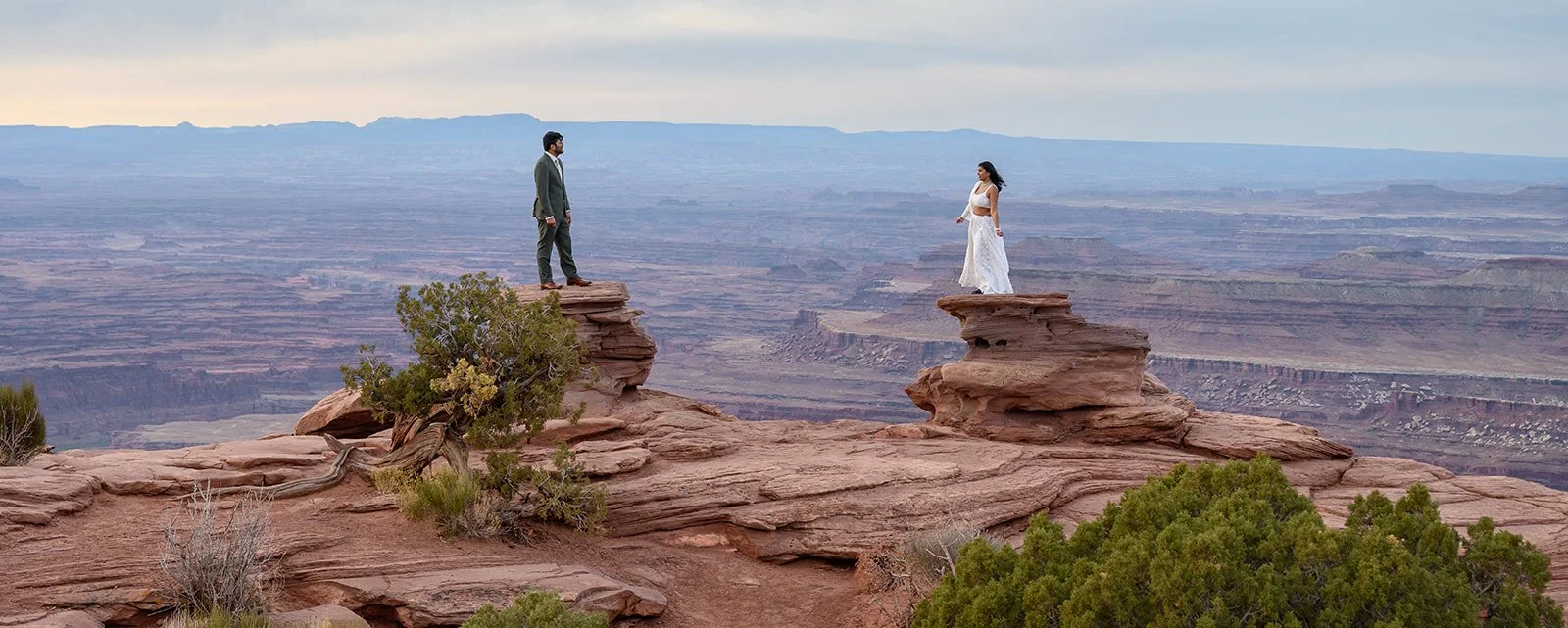
Dead Horse Point State Park, thirty minutes from Moab, has a view over the Colorado River goosenecks that honestly rivals anything in Canyonlands. Weddings there need a special use permit, they take groups from a handful of people up to 100, and applications are accepted one to eighteen months ahead. Spring and fall book fast, and they don't approve Memorial Day weekend. Drones are prohibited in the park from March through October.
Public land around Moab opens up enormous options: mesa tops, slickrock, river bottoms and slot canyons, many of them a few minutes from town. Rules vary by agency and some spots need their own permit, so this is something we sort out together in planning.
Other worth knowing: Goblin Valley State Park, Kodachrome Basin State Park, Snow Canyon near St. George, the Valley of the Gods, and the Grand Staircase Escalante country between Bryce and Capitol Reef. Monument Valley sits on Navajo Nation land and has its own permit process and guide requirements, which is a completely separate system from the national parks.
I've written more about this in my guide to the top 5 Moab elopement locations beyond Arches National Park, and if you've never seen a desert night sky, my post on Moab's dark skies makes the case for staying out after dark.
The Rules Every Utah Park Has in Common
Once you've read five permit pages you start to notice they're all saying the same six things.
Your permit does not give you the place to yourselves. Other visitors stay. Nothing gets roped off. This matters less than you think, because a good photographer works angles and timing, and sunrise solves most of it.
No decorations or structures. No arbors, no balloons, no signage, no aisle runners. Hold your flowers.
Nothing gets thrown or released. No rice, no petals, no birdseed, no lanterns, no butterflies, no confetti.
No amplified sound. Keep music and voices at conversation level. Acoustic and quiet is fine.
No drones. Not in any national park.
Plan around crowds and parking, not just light. Weekends and holidays in spring and fall are busy, and full parking lots are a real risk at the popular trailheads.
Your Utah Marriage License
This part is simpler than the permits.
A Utah marriage license costs $50 and includes one certified copy. Both of you have to appear in person at a county clerk's office with a current photo ID that proves your date of birth. There's no waiting period, so the license is effective immediately, and it expires 32 days after you buy it. A license issued in one Utah county is valid anywhere in the state, so you can get it in Moab and use it in Zion.
Utah law requires at least two people aged 18 or older to witness your declarations and the pronouncement. That's worth planning for, especially if you were imagining just the two of you. Your photographer and your officiant can often be two of them, and I've signed plenty of licenses.
The clerk's offices near the parks are Washington County in St. George for Zion, Grand County in Moab for Arches and Canyonlands, Garfield County for Bryce, and Wayne County for Capitol Reef. Hours are business hours on weekdays, so build the license pickup into your trip and don't leave it to the morning of.
When to Go
Spring, roughly March through May. The best all around window. Wildflowers, moderate temperatures, and green in Zion. It's also the busiest season along with fall, so permits and lodging need to be booked early.
Fall, September through October. My favorite. Cooler than summer, the crowds thin after Labor Day, and the cottonwoods in Zion and the orchards in Capitol Reef turn gold.
Summer. Hot is an understatement. Moab regularly runs over 100 degrees and there is almost no shade in Arches or Canyonlands. If you're set on summer, we go at sunrise, we're finished by nine, and we do a second session at sunset. Afternoon thunderstorms also bring flash flood risk in canyons and washes, which is not something to gamble with.
Winter. Quiet, cheap and gorgeous. Snow on red rock is unbelievable. Bryce at 8,000 feet gets real winter, roads can close, and Cathedral Valley may be unreachable. For the right couple this is the best kept secret in Utah. If snow sounds good, read my guide to winter elopements.
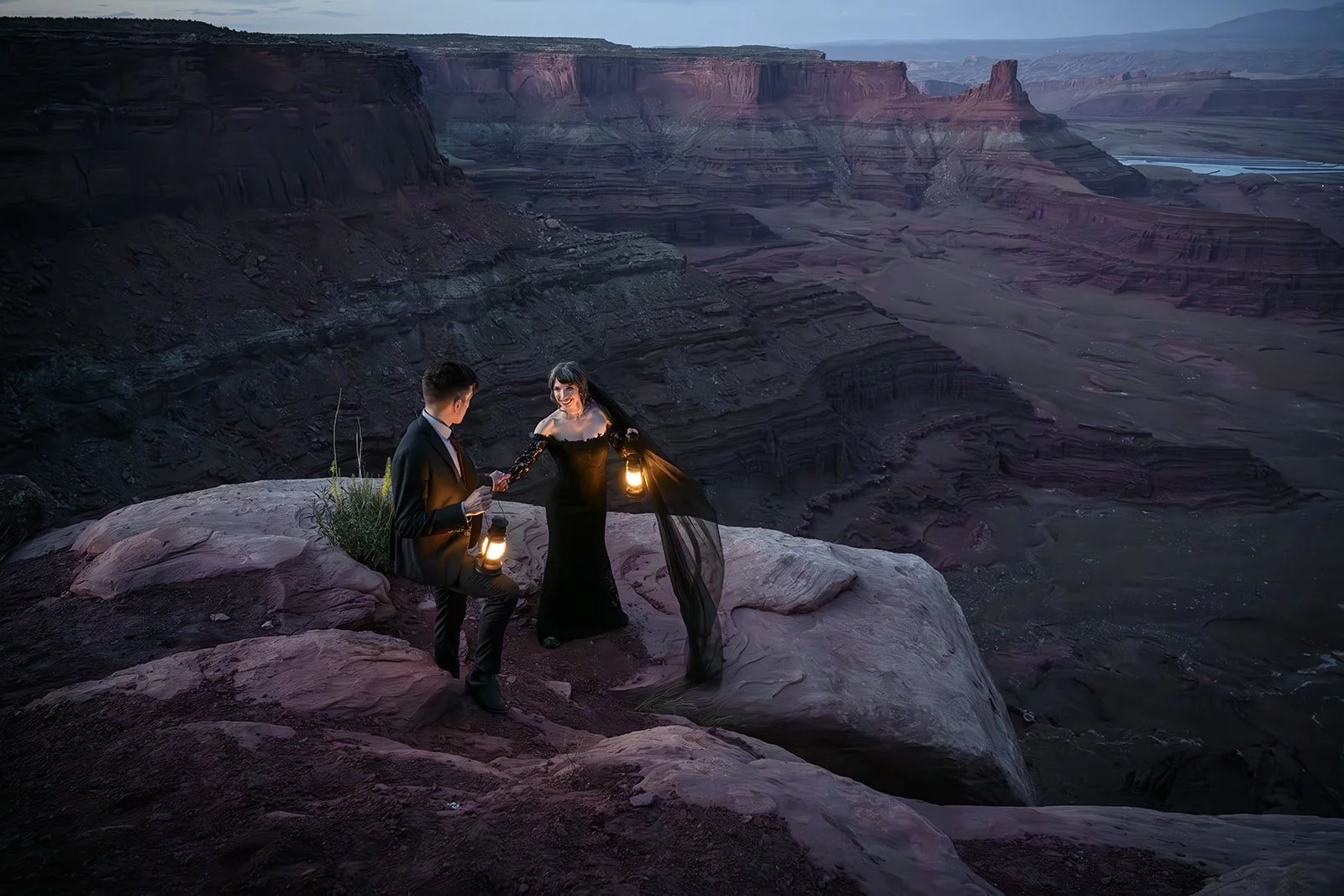
Time of day beats time of year. Sunrise is the answer in every one of these parks. Empty viewpoints, soft warm light on sandstone, and cool enough to wear a suit. Sunset is the second best, and the hour after sunset in the desert is when the rock turns purple and the stars come out.
What to Actually Plan For
Heat and water. Carry more water than feels reasonable, for you and your guests. I bring extra.
Shoes. Hike in real shoes and change at the ceremony spot. Slickrock is slick and sand eats heels.
Wind. The desert is windy in spring. Veils are beautiful and they are also a sail. Bring pins.
Your dress and the dirt. Red dust gets on everything and mostly comes out. Bring a sheet or a blanket for the car.
Elevation and distance. Bryce is at 8,000 feet. The Needles is ninety minutes from Moab. Cathedral Valley may require high clearance. Drive times between parks are longer than the map suggests.
A weather backup. Flash floods, road closures, snow at Bryce, heat advisories. Every plan I build with a couple has a second version.
For more on how a full day comes together, read my two day elopement timeline, and if you want somewhere comfortable to come home to at night, I have guides to where to stay for a Zion elopement weekend and the best places to stay in Moab.
A Sample Two Park Weekend
This is the itinerary I recommend most often, and it covers the two parks that look least alike.
Day one, Moab. Arrive, pick up your marriage license at the Grand County clerk, settle in. Sunset at Dead Horse Point or on public land outside town, with no permit stress and no crowd.
Day two, Arches. In the park before sunrise. Small private ceremony at Double Arch or The Windows under your permit. Portraits while the light is still low, then breakfast in Moab and a long middle of the day break. Late afternoon back out for the hike to Delicate Arch, then stars after dark.
Day three, Canyonlands. Sunrise at Grand View Point at Island in the Sky. Slow morning, drive home, or keep going toward Capitol Reef and Bryce if you have the time.
That's three completely different landscapes, two permits, one license and zero rushing.
Frequently Asked Questions
Do you need a permit to elope in a Utah national park?
Yes. All five Utah national parks require a special use permit for any wedding, elopement or vow renewal, no matter how small the group. Zion, Bryce Canyon and Capitol Reef charge a $100 application fee. Arches and Canyonlands charge $185 plus cost recovery monitoring fees. You also need to hold your ceremony at one of the park's approved locations.
Can you get married at Delicate Arch?
No. Delicate Arch is not one of the approved ceremony locations in Arches National Park. Approved sites are Park Avenue, Double Arch, The Windows, La Sal Mountains Viewpoint, Panorama Point and the Devils Garden Campground Amphitheater. You can still hike to Delicate Arch for portraits after your ceremony.
How many guests can you have at a Utah national park elopement?
It depends entirely on the site. Limits range from 10 at Menu Falls in Zion and 15 at Park Avenue in Arches, up to 75 at the Zion Lodge Lawn, 80 at the Devils Garden Amphitheater and 100 per location at Capitol Reef. Bryce Canyon caps every ceremony at 30 guests.
What is the best time of year to elope in Utah?
Spring and fall. April through May and September through October give you moderate temperatures and the best conditions. Summer is dangerously hot in Arches, Canyonlands and Moab, and winter is beautiful and quiet but brings snow and road closures, especially at Bryce Canyon at 8,000 feet. Whatever the season, sunrise is the best hour.
How do you get a marriage license in Utah?
Both of you apply in person at any Utah county clerk's office with photo ID proving your date of birth. It costs $50, includes one certified copy, has no waiting period and expires after 32 days. A license from any county is valid statewide, and Utah requires at least two witnesses aged 18 or older at your ceremony.
Do you need a timed entry reservation for Arches?
Not for 2026. Arches lifted its timed entry reservation requirement, so you can enter any time during operating hours with a valid entrance pass. Expect crowded parking at popular spots during peak season, and note that Devils Garden Campground and the Fiery Furnace still require their own reservations.
More Utah Planning Guides
Why Utah Is the Best Place to Elope: National Parks, Hidden Gems and Planning Tips
Two Day Elopement Timeline: Creating the Wedding of Your Dreams
Your Love. Your Story. Your Way.
Five parks, five permit applications, a marriage license with a 32 day clock on it and a whole lot of driving. That sounds like a lot, and it is exactly the part I take off your plate.
I'll help you pick the park that matches the day you want, file the permit, time the light, find the backup plan for the weather, and build a timeline that leaves you plenty of room to actually enjoy the desert you flew out to see.
Reach out here and let's plan it.